
How to Be a Wrestler Champion.

To become a champion wrestler is not a matter of weeks, but five things working together over the course of years: technical mastery of fundamentals, physical conditioning designed for wrestling (not general fitness), mental preparation, safe and legal weight management, and consistent high quality competition and coaching. There are no shortcuts to substitute any of these. This book is for wrestlers, parents and coaches looking for a practical, realistic response, not a motivating pep talk. This book shows you what to train, how to train it and how to avoid the errors that kill most wrestlers before they ever reach a championship level.
Key Takeaways
-
There’s hardly one “secret” move or training skill that all championship-level wrestlers have. Five pillars form the foundation for championship level wrestling. Technique, wrestling specialised training, mental preparedness, safe weight control and great coaching/competition.
-
Wrestling strength training is different than bodybuilding. This is not about increasing muscle with discrete movements, but instead total body power, explosive endurance, and cardiovascular stamina.
-
Heavy regulation of weight-cutting is for good reason. Rapid weight loss impairs performance and health hence NFHS and NCAA standards limit minimal body fat and safe weekly weight decrease.
-
Most wrestlers who make it to state or national championship level have trained 5-10+ years before they earn their first big title. There are seldom any real shortcuts.
-
The wrestler’s surroundings (quality of coaching, practice partners and programme structure) has a quantifiable impact on growth, which is why club and team organisation matter as much as individual effort.
What Really Does It Take To Be A Champion Wrestler?
Any serious wrestling development plan covers the same five topics. Oftentimes skipping any one of them is the difference between a good club wrestler and a state or national champion.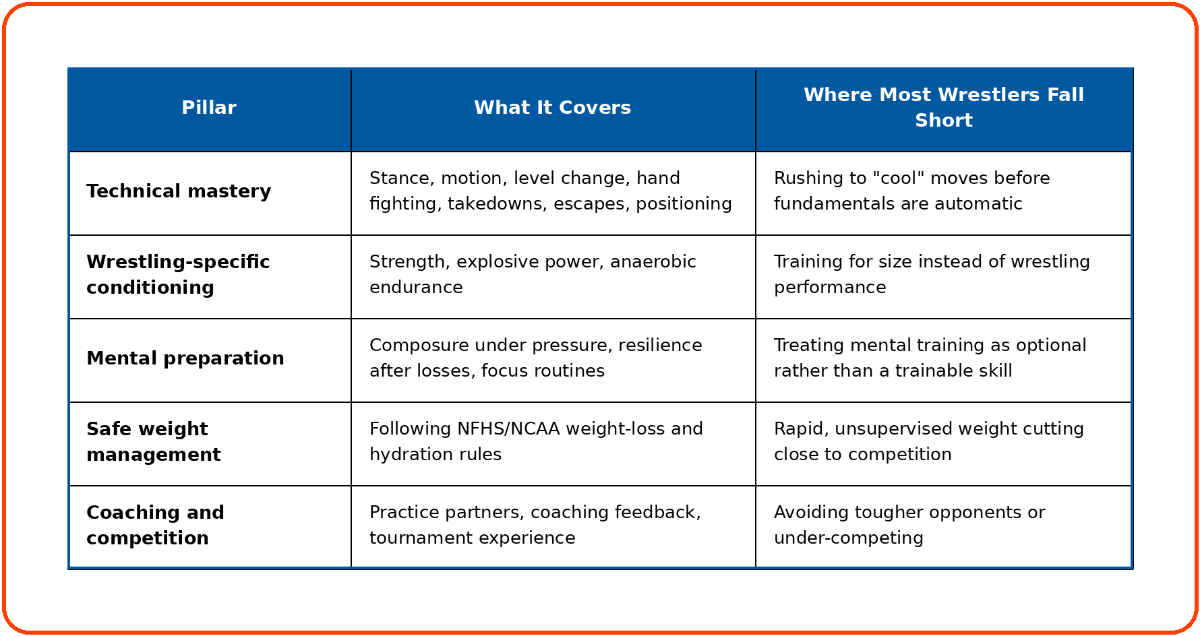
What fundamentals do champion wrestlers learn first?
First and foremost, champion wrestlers learn stance, motion, level adjustments and hand fighting since these basic skills decide if all other techniques work in live situations.
Developing wrestlers are always tempted to throw the highlight reel move early in their careers. But a wrestler with a poor base or bad hand fighting will have his high-caliber stuff stopped dead in its tracks. 1A constant focus on the basics pays dividends on all levels, and posture, motion, hand fighting and positioning are the foundation of everything a wrestler performs on the mat.
Which means intentionally drilling the dull stuff. Penetration step. Sprawl. Hip placement. Hand control. Repeat until they hold up under fatigue and resistance. We notice over and over again that wrestlers who plateau are typically missing something basic, not something advanced.
What kind of physical conditioning should a wrestler follow to get to championship level?
Wrestling conditioning at the champion level is predicated on full body strength, explosive endurance and wrestling specific stamina, not bodybuilding style muscle isolation. Wrestlers need whole-body power, explosive endurance and cardiovascular stamina. Strength training for wrestlers is not like bodybuilding, where you isolate muscle areas.
This is why wrestling specific conditioning programmes are different than your average gym programme. Conditioning activities such as sled pushes, bear crawls, rope climbs and circuit training mirror the dynamic demands of a wrestling match, boosting both anaerobic endurance and explosive strength. wrestling Endurance training is often the difference between decent wrestlers and great ones. Matches are won and lost in the third period as much as the first.
A typical competitive wrestler’s weekly schedule usually looks like:
-
3 to 5 technical practice sessions (drilling and live wrestling)
-
2 to 3 strength and power sessions focused on hips, legs, grip, and core
-
1 to 2 conditioning-specific sessions (circuits, sprints, sled work)
-
At least one full recovery day
How Crucial Is Mental Toughness To Becoming A Wrestling Champion?
Mental toughness in wrestling is not a personality feature, it is a talent that can be trained. It takes the same repetition as physical technique. To build mental toughness is to practice repeatable mental skills . Identify which skill breaks down first ( confidence , resilience , focus , commitment , pressure ) . Develop a reset procedure to get back on track when something breaks down in training .
This is important because wrestling is one of the only sports where a single scramble may turn a bout around. A wrestler trained to remain calm after surrendering a takedown will bounce back faster than a wrestler who hasn’t. Elite programmes do not see this as afterthoughts, nor do huge competitions. They take this as seriously as physical training.
One good cheap habit for growing wrestlers: after every session or contest, write down one item that disrupted your composure and one particular strategy to reset next time. It provides a personal playbook for maintaining mental steadiness over a season. And that’s what differentiates wrestlers who crack under pressure from those who don’t.
How can champion wrestlers get around weight safely?
Champion wrestlers don’t lose weight quickly before the season; they do it slowly and under supervision. Unsafe cutting has caused genuine damage to the sport, which is now tightly governed by state sports bodies and the NCAA.
This is one of the most misunderstood aspects of wrestling and demands specific, factual attention rather than blanket “eat healthy” recommendations.
The rules that govern weight cutting exist for a reason. The NFHS requires wrestlers to weigh in at a hydrated state (specific gravity no more than 1.025) before their first match of the season, at which point their baseline body fat percentage is assessed, and a safe minimum weight is set based on a body fat minimum of no less than seven percent for males and 12 percent for females. For the remainder of the season, a wrestler's weight must stay at or above that safe minimum weight.
Rapid weight loss is capped, not unlimited. NCAA rules prohibit losing more than 1.5% of body weight per week between the first weigh-in and the first meet, to ensure the projected weight does not put the wrestler below 5% body fat.
Dehydration is not a shortcut. It's a performance killer. Dehydration is considered the worst method of losing weight because it causes a quick decline in strength, endurance and mental alertness, and symptoms can become noticeable after as little as a 2% loss of normal water volume.
Youth wrestlers should not be cutting weight at all. Cutting weight is not encouraged for wrestlers under the age of 14 and any risk should be confined to occasional important contests such as state or national events.
The practical takeaway for parents and coaches is simple: Work with a coach and qualified assessor, where needed, to define a realistic weight class months in advance, not days.
How long does it take to actually become a champion wrestler?
The vast majority of wrestlers who win a state or national title have been training 5 to 10 years before that first big victory because wrestling rewards accumulated technical repetition more than nearly any other sport.
Here, size is important. 300,214 high school participants in boys wrestling in 2024-25 nationally 19 | Girls wrestling reached 74,000 participants for the first time in 2024-25, up 15% from the prior year. It takes persistent progress to be recognised amongst hundreds of thousands of athletes fighting for a finite number of state titles, not just one good season.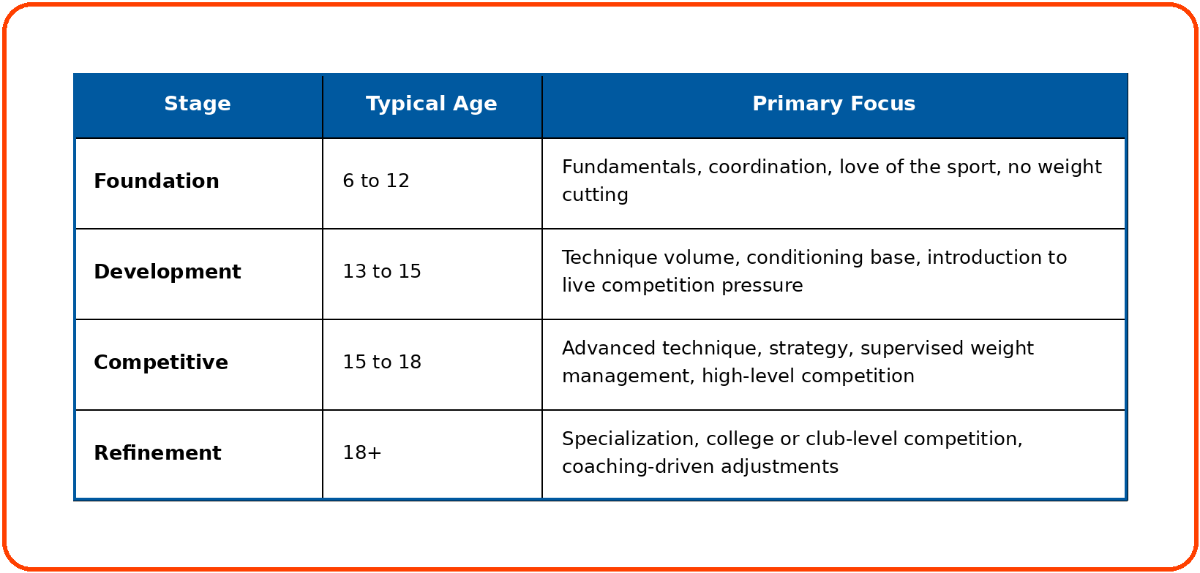
A wrestler who starts wrestling at 8 and makes a state final at 17 has around 10 years of mat time under his belt. Wrestlers that start later can definitely get up to a high level, but the schedule gets compressed and coaching quality and training efficiency become much more crucial.
What role do coaches, practice partners and competition play?
This is why selecting a rigorous training partner is just as important as finding a competent instructor. The quality of practice is determined by the person in the room who is working the hardest, not the effort of the wrestler alone. One simple technique to get the most out of practice is to ask the most difficult person in the room to be a training partner.
Coaches do more than practice technique. They see the mental or technical breakdown a wrestler doesn’t see in himself. They set the intensity of live wrestling sessions. No matter how talented, a wrestler, who trains alone, or exclusively against weaker opponents, will hit a ceiling. But regular, varied competition (not just practice) is what exposes deficiencies that need to be rectified before a championship run.
What Common Mistakes Keep Wrestlers From Reaching Champion Level?
-
Training only for the next tournament instead of long-term skill development. Wrestlers who chase short-term results often skip the unglamorous fundamentals work that pays off years later.
-
Avoiding tougher practice partners. Comfortable practices build comfortable wrestlers.
-
Treating recovery as optional. Skipped sleep and recovery days quietly erode strength and technique gains.
-
Unsafe or last-minute weight cutting. This is both against the rules in most states and directly damages performance, as covered above.
-
Ignoring the mental side of the sport. Physical training without composure and reset routines leaves wrestlers vulnerable in close, high-pressure matches.
-
Inconsistent practice attendance. Wrestling technique is built through repetition; missed practices compound over a season.
How might wrestling programmes help athletes on their way to become champions?
The majority of a wrestler’s progress is self-driven but the programme surrounding them, consistent practice schedule, open communication with parents, and organised competition logistics removes friction that otherwise eats into training time.
Wrestling clubs and school programmes typically have the same amount of work to manage: registering players for the season, managing rosters and weight classes, scheduling practices and matches, and keeping parents and coaches on the same page about changes. Wrestling management software helps clubs, teams, coaches and players handle programme registrations, payments, scheduling, teams, players and staff all from one system. For a programme with dozens of participants in numerous weight classes and age divisions, that kind of central organisation takes the administrative pressure off the coaches, so they can spend more time actually coaching.
SportsPlus provides this kind of wrestling program management, covering registration, payments, scheduling, and team communication, which is worth exploring for clubs and associations trying to run a tighter, more consistent program.
Frequently Asked Questions
What's the fastest way to become a better wrestler?
No actual shortcut. The fastest realistic gains are made by drilling fundamentals (stance, movement, hand fighting) every day and obtaining regular live wrestling reps against harder partners since technique only holds up under duress after heavy repetition.
How many hours a day do competitive wrestlers train?
Competitive wrestlers train an average of 5-6 hours a day. The training volume depends on age and level, but competitive high school and club wrestlers usually train 1.5 to 3 hours per day during the season, including technical practice, live wrestling and strength or conditioning work, with smaller loads for younger athletes.
In wrestling, which is more important, power or skill?
At higher levels, with equally strong opponents, technique usually prevails over brute force. Strength and conditioning support technique by allowing a wrestler to perform manoeuvres under fatigue and against resistance, but it is not a replacement for technical expertise.
What is the most weight a wrestler may cut safely in a week?
NCAA guidelines recommend no more than 1.5% of weight reduction per week from the initial weigh-in to the first meet. This rule was put into place to avoid the fast, hazardous cutting that was widespread in the sport.
How low can a high school wrestler go (in terms of body fat percentage)?
NFHS standards provide a healthy minimum weight for each wrestler based on a minimum body fat of no less than seven percent for males and 12 percent for ladies. No wrestler shall compete at a weight below his certified minimum weight for the season.
Do youth wrestlers have to cut weight to compete?
Nope. Most child competitions include pooled or age-based weight groups designed to minimise that pressure, and cutting weight is not suggested for wrestlers under the age of 14.
How to establish a champion mindset for wrestling?
By seeing mental skills as something that can be trained, like technique is trained. This involves figuring out which mental skill breaks first under pressure, developing a reset process, and using techniques such as visualisation and positive self-talk to improve focus and performance.
How long does it take to be a state champion wrestler?
Most state champions have trained for about 5 to 10 years before winning their first title, steadily improving their technical talent, conditioning, and experience in competition, rather than hitting a peak suddenly in one season.
What is the Difference Between Freestyle, Greco-Roman, and Folkstyle Wrestling?
Folkstyle is the style of scoring in U.S. school and college wrestling, which emphasises control and positioning. Freestyle and Greco-Roman are the Olympic styles. In freestyle you can attack the legs; in Greco-Roman you can't attack below the waist. Wrestlers may compete in multiple styles in different seasons.
What should a wrestler consume to help with performance and weight management?
Good nutrition- smart portions, lean proteins to build and restore muscle, complex carbohydrates for long-lasting energy-is the basis of safe weight management and optimal performance. What you eat is important, but so is how you eat it, especially in the days leading up to competition.
What are ways a wrestling club or team might boost athlete growth outside of individual training?
Organised scheduling, clear coaching/parent communication, and smooth registration and tournament logistics all free up coaching time and cut down on missed practices, both of which directly impact an athlete's development curve.
Year-round specialisation in wrestling: good or bad for long-term development?
This is very much an individual athlete decision and should be explored with a coach or sports medicine expert. The data on early single-sport specialisation is mixed and sport-specific, so it doesn't lend itself to a blanket rule here.
What is a realistic training split for a competitive wrestler per week?
The average programme is 3-5 technical/live wrestling sessions, 2-3 strength and power sessions, 1-2 conditioning sessions, and at least one full recovery day, adjusted for age and competition schedule.

Nathan Uppara
Digital Marketing Lead at SportsPlus
Nathan Uppara is the Digital Marketing Lead at SportsPlus, where he helps sports organizations discover better ways to manage registration, payments, scheduling, communication, websites, and mobile apps. He combines his experience in digital marketing and sports technology to create practical content and resources for clubs, leagues, and sports organizations.
Recent

What Should a Modern Sports Organization Website Actually Do?
Oct 2, 202633
Why Generic Website Builders Dont Work for Sports Organizations
Sep 18, 202651
SportsPlus Release Notes-June 30, 2026
Jul 1, 202669
SportsPlus Release Notes-June 09, 2026
Jun 10, 202680
SportsPlus Release Notes-May 19, 2026
May 20, 202671


