
How to Become a Professional Wrestler.

Becoming a professional wrestler often begins with supervised training at a respected professional wrestling school. You have to master safe foundations in the ring, work on your conditioning, establish a credible character, get your trainer’s approval to compete and gain experience through independent promotions from there. Most newbies don’t find themselves applying for WWE or participating in a large tryout as their first step in the path.
This guide is for aspiring wrestlers, sports-entertainment fans, and parents helping an older teen explore the field. You’ll learn how to select a credible school, get in shape, evaluate costs, grasp licensing, secure early bookings and follow bigger prospects without mistaking a first match for a sustainable career.
Key takeaways
-
Start with qualified instruction. Do not attempt to teach yourself bumps, throws or other wrestling techniques at home.
-
Professional wrestling requires more than athletic ability. You must learn safety, timing, communication, character work, promos and audience psychology.
-
A debut is only one milestone. Being cleared for a first match does not mean you are ready for consistent paid work or a major contract.
-
Evaluate the school, not just the owner’s name. Ask who teaches daily classes, how students progress and what safety procedures are in place.
-
Budget beyond tuition. Medical requirements, licenses, gear, conditioning, food, travel and promotional materials can cost as much as the initial training.
-
Treat every booking like business. Confirm the date, venue, payment, travel terms and expectations in writing.
The professional wrestler career roadmap
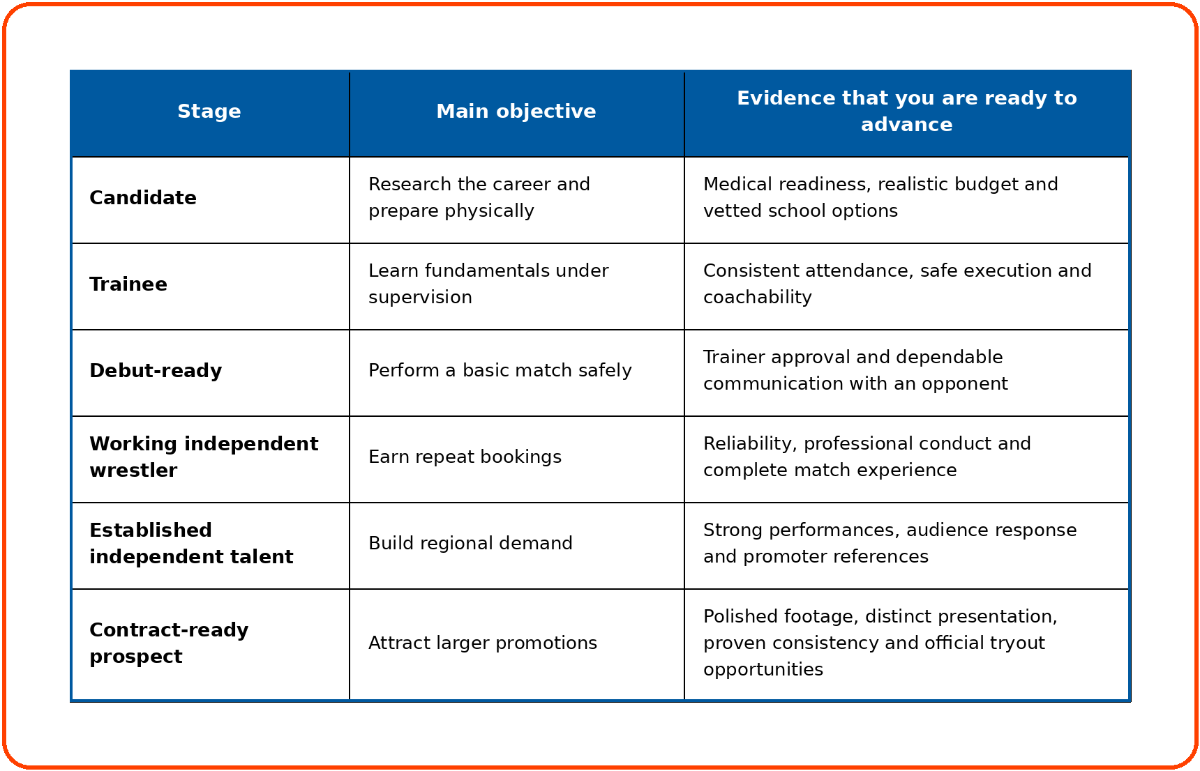
This is an editorial career structure, not an industry accreditation. The point is to keep newcomers from thinking that once they get into a school or play a single match, they’re done developing.
What Does It Take To Be A Pro Wrestler?
A professional wrestler is a trained performer that blends athletic movement, cooperative in-ring action, character depiction and live entertainment for a wrestling promotion.
This page is about independent professional wrestling and sports entertainment. The path is not the same as that to becoming an Olympic, freestyle, Greco-Roman, folkstyle or college wrestler.
Professional wrestling relies on scripted narrative and pre-determined results, but the physical activity still demands professional performers. WWE says its performers are highly skilled athletes and entertainers who must bring personalities to life.
A useful distinction is:
-
A trainee is learning in a school.
-
A debut-ready performer has been approved to work a basic match.
-
A working wrestler receives bookings from promotions.
-
A full-time professional earns enough consistent income to make wrestling a primary occupation.
-
A contracted wrestler has an agreement with a specific promotion.
These stages can overlap, but they are not interchangeable.
What Are The Qualifications To Be A Pro Wrestler?
You require physical readiness, qualified training, coachability, performance ability and professional reliability in general. You don't need to have one universal college degree, body type, or amateur wrestling background.
Requirements differ by school and location. Many established schools set 18 as the normal minimum age. Reality of Wrestling accepts most students at 18 but may accept selected 16- and 17-year-olds with parental permission. Create A Pro and Black and Brave list 18 as their standard minimum. 5
A little experience can assist, but it’s not always necessary. Schools usually take beginners and WWE also recruits from wrestling, football, track and field, gymnastics, acrobatics and other sports.
Helpful backgrounds include:
-
Amateur wrestling
-
Gymnastics
-
Martial arts
-
Football or rugby
-
Track and field
-
Dance
-
Cheerleading
-
Theater
-
Improvisation
-
Public speaking
-
Strength and conditioning
Success is not guaranteed. A gifted athlete unable to communicate, listen or act for an audience may be as challenged as an entertainer who cannot physically train properly.
How Do You Become a Professional Wrestler?
The usual route is to toughen up your physique, train at a proper school, get cleared for a first match, get experience on the independents and build up a pro reputation.
1. Decide What Kind of Wrestling Career You Want
Start by defining the goal.
Do you want to:
-
Want to pursue pro wrestling as a serious hobby?
-
Play regularly on independent shows locally?
-
Make an independent career full-time?
-
Want to chase WWE, AEW, TNA, NJPW or perhaps another large promotion?
-
Referee, Manager, Announcer or Producer in the Wrestling Business?
Your aim influences where you practice, how much you spend and if moving is realistic. If you’re looking for occasional local engagements you don’t necessarily require the same programme as someone who’s prepared to move across the country for an intense academy.
Be honest about the time frame. Training is usually many evenings a week and shows are regular on weekends. The travel time, setting up, sitting around and doing the post-show duties might take a lot longer than the match itself.
2. Get a Sports Physical and Discuss Your Medical History
The first step to training to be a professional wrestler is to be honest about your health.
A preparticipation physical evaluation can discover health problems that need to be treated or evaluated further before participation. The usual assessment covers cardiovascular, neurological, pulmonary, musculoskeletal and mental health issues.
Tell the clinician about:
-
Previous concussions
-
Neck or back injuries
-
Shoulder or knee instability
-
Heart symptoms or family cardiac history
-
Asthma
-
Seizures
-
Current medications
-
Previous surgery
-
Recent unexplained fainting
-
Mental health concerns that may affect training or recovery
Pro wrestling is a rough business. In a 2024 retrospective analysis of 181 professional wrestlers treated at a single hospital in Japan, lower extremity ailments accounted for approximately half of all injury sites, with the knee being the most frequent. The study is helpful in understanding possible injury patterns but the sample of one hospital cannot be used as a general injury rate.
3. Build an Athletic Base Before Your First Class
You don't have to be TV-handsome to start at a school, but you'll learn better if you come with basic strength, endurance, mobility and movement control.
Your preparation should address:
-
Full-body strength
-
Aerobic endurance
-
Repeated high-intensity effort
-
Balance and body awareness
-
Hip, ankle and shoulder mobility
-
Core control
-
Landing and deceleration mechanics
-
Sleep, hydration and recovery
A competent strength and conditioning professional will be able to tailor the programme to your age, training history and medical needs.
WWE in particular emphasises that backyard wrestling is harmful and not a way to recruit.
4. Find a Reputable Professional Wrestling School
A good wrestling school teaches safety, fundamentals, performance and professional conduct through supervised progression.
Do not choose a school based only on:
-
A famous name in the logo
-
Social media follower counts
-
Championship photos
-
Promises of guaranteed bookings
-
Claims that scouts attend every class
-
A short highlight video
Ask who conducts normal classes. A well-known owner may appear occasionally while other trainers handle most instruction. That arrangement can still produce good training, but you should know what you are buying.
Visit the facility if possible. Observe how instructors speak to students, how many trainees share the ring and whether beginners are pressured into advanced activity.
How Can You Tell if a Wrestling School Is Legitimate?
Use the SAFE RING framework to evaluate the school before paying nonrefundable tuition.
S: Staff Credentials
Ask:
-
Who teaches the beginner classes?
-
How long have the trainers coached?
-
Where have they performed?
-
Can their work history be verified?
-
Are they present consistently?
-
Who watches the class if the head trainer is not there?
Just because a former wrestler does not make anybody a qualified instructor. Find trainers who can explain progression, correct technique and handle varying levels of experience.
A: Athlete Safety
Ask whether the school has:
-
A written emergency action plan
-
First-aid supplies
-
A clear concussion response process
-
Emergency contact procedures
-
Rules for reporting injuries
-
A policy against training while impaired
-
A process for returning after injury
The National Athletic Trainers’ Association lists preparticipation examinations, concussion treatment and emergency action planning as essential sports safety procedures.
If you feel a headache, dizziness, nausea, confusion, visual problems, unusual exhaustion or memory disorders following a hit or fall, discontinue play and seek medical assessment. According to CDC recommendations, certain concussion symptoms may not occur until hours or days later. Headache gets worse. Vomiting repeatedly. Seizures. Slurred speech. Severe confusion or trouble waking up. Emergency treatment is needed.
F: Facility and Equipment
Look for:
-
A properly maintained ring
-
Secure ropes, turnbuckles and padding
-
A clean canvas and training area
-
Adequate space around the ring
-
Appropriate temperature and ventilation
-
Rules for cleaning shared equipment
-
Controlled access during training
-
A reasonable coach-to-student ratio
A ring can look impressive in photographs while still being poorly maintained. Inspect it in person.
E: Explicit Curriculum and Financial Terms
Request written details covering:
-
Tuition
-
Payment schedule
-
Refund policy
-
Program duration
-
Required equipment
-
Missed-class policy
-
Expected event work
-
Medical or licensing requirements
-
Criteria for moving to advanced training
-
Conditions for dismissal
Be cautious if the school refuses to explain when or how students are evaluated.
R: Real Graduate Outcomes
Ask for graduates you can verify independently.
Do not focus only on one person who reached television. Look for evidence that ordinary graduates:
-
Completed training safely
-
Worked legitimate independent events
-
Earned repeat bookings
-
Continued training after graduation
-
Were prepared to work with different opponents
I: In-Person Observation
A good programme should be able to explain what is it doing. Some colleges let prospective students sit in on a class, attend an introduction session, or visit by appointment.
See the culture. Hard training is not an excuse for humiliating, discriminating, hazing or retaliating against pupils who report an injury.
N: Network Into Legitimate Events
A school connected to a functioning promotion can provide supervised opportunities to:
-
Observe live production
-
Help with event setup
-
Learn backstage etiquette
-
Work student showcases
-
Meet reputable promoters
-
Receive feedback after a match
Connections are valuable, but a school should not guarantee a major contract.
G: Governance and Professional Conduct
Ask who is responsible for:
-
Waivers and medical documents
-
Local commission requirements
-
Insurance
-
Student conduct
-
Safeguarding younger participants
-
Complaint handling
-
Photography and video permissions
-
Personal data security
Rules vary by jurisdiction. Arkansas, for example, requires professional wrestling participants covered by its rules to obtain a commission license and submit an annual physical. OVW states that Kentucky requires its trainees and performers to obtain a Kentucky Boxing and Wrestling Commission license and physical.
What Do You Learn in Professional Wrestling School?
Professional wrestling school teaches controlled performance, not simply a collection of moves.
A beginner curriculum may include:
-
Warmups and conditioning
-
Footwork
-
Ring positioning
-
Basic rolls
-
Supervised bump progression
-
Running the ropes
-
Lockups and holds
-
Communication with an opponent
-
Match structure
-
Selling
-
Ring psychology
-
Character development
-
Promo delivery
-
Audience interaction
-
Referee communication
-
Backstage etiquette
-
Event setup and teardown
Some schools also teach camera presentation, production, writing, social media and financial management. OVW’s current certificate program, for example, lists sports performance, television production, writing, on-camera presentation, marketing and financial management alongside in-ring training.
It is not to execute the biggest move possible. The idea is to present a coherent story and defend yourself your opponent the referee and the audience.
How Much Does it Cost to Train to be a Professional Wrestler?
You might pay several thousand dollars to learn pro wrestling, but there are many various ways schools will take your money. Tuition can be charged monthly, yearly, by the quarter or by the intensive course.
Here are some examples that are publicly available as of September 16, 2026. They are not endorsements and prices may vary.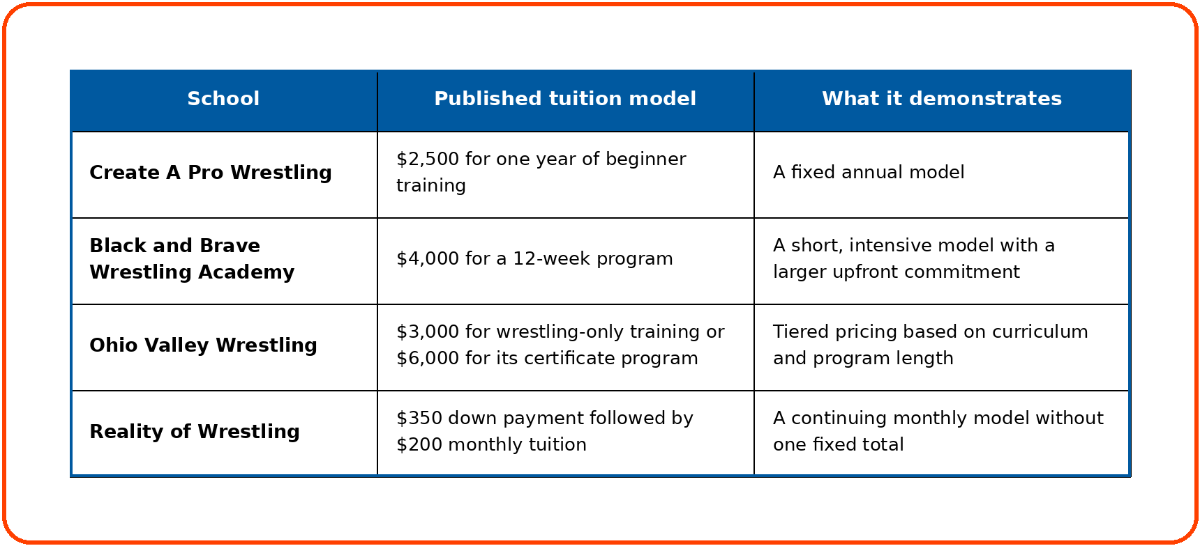
Tuition is only part of the budget. Other possible expenses include:
-
Sports physicals
-
Commission licenses
-
Blood testing where required
-
Wrestling shoes
-
Knee pads
-
Training clothes
-
Gym or conditioning fees
-
Food and hydration
-
Travel
-
Lodging
-
Ring gear
-
Promotional photographs
-
Video editing
-
Insurance
-
Rehabilitation
-
Taxes
Determine the total cost of attending regularly for at least six months before you sign up. A school that costs less but forces you to travel large distances can end up costing you more than a more expensive school close by.
How long does it take to train to become a wrestler?
You may learn enough fundamentals to get into a basic match within a few months, but it normally takes a lot longer to become a reliable working wrestler.
Create A Pro states that its students may take approximately three months to one year to acquire the basic skills needed for a basic match. Other published programs range from 12-week intensives to year-long courses. These are program structures, not guaranteed career timelines.
A realistic progression looks like this:
-
First months: Conditioning, movement and basic safety
-
Later beginner training: Holds, sequences, selling and communication
-
Trainer-approved debut: A controlled match with appropriate supervision
-
First year of performances: Learning to adapt to different opponents and audiences
-
Following years: Building a regional reputation, improving presentation and seeking higher-level bookings
Progress depends on attendance, health, previous athletic experience, coaching quality and how safely you apply feedback.
A trainer should decide when you are ready to debut. Tuition paid or time served should not automatically qualify you for a match.
How Do You Get Your First Professional Wrestling Booking?
Your trainer or school is usually the safest first connection to a legitimate promotion.
Before contacting outside promoters, ask your trainer whether you are ready and what material you should send.
A basic booking package may include:
-
Ring name
-
Legal contact information
-
Current location
-
Travel radius
-
Clear headshot
-
Full-body promotional photo
-
Short character description
-
Trainer and school
-
Experience level
-
Links to complete matches
-
A short promo clip
-
Reliable contact details
-
Available dates
Don't tell me it's not real. Don’t send a publicist dozens of files, or unsolicited plot ideas, or daily repeated messages.
Once booked:
-
Confirm the date and venue.
-
Confirm arrival time.
-
Ask who your on-site contact will be.
-
Confirm payment and travel terms.
-
Ask what documents or licenses are required.
-
Arrive early.
-
Introduce yourself professionally.
-
Follow the promoter’s and trainer’s instructions.
-
Protect your opponent.
-
Thank the appropriate staff before leaving.
You’ll hear enough about early career momentum being based on being good enough to book again, not on doing the most memorable stunt on the show.
How Do You Develop a Wrestling Character?
A good wrestling character is a simple, exaggerated representation of a person the audience can identify with very easily.
Start with four questions:
-
Who are you?
-
What do you want?
-
Why should the audience care?
-
How does your behavior change once the match begins?
Avoid copying a current television performer’s appearance, phrases or mannerisms. Promoters need to understand what makes you different.
Your presentation should be consistent across:
-
Ring name
-
Clothing and gear
-
Entrance
-
Facial expressions
-
Movement
-
Promo language
-
Social media
-
Match behavior
A character does not need an elaborate fictional backstory. A recognizable attitude, motivation and point of view are often more useful.
Practice promos with a clear structure:
-
Identify the opponent or situation.
-
State the conflict.
-
Explain what is at stake.
-
Show an emotion.
-
Finish with a memorable promise or challenge.
What Business Skills Does an Independent Wrestler Need?
An independent wrestler must manage bookings, travel, income, expenses and professional communication.
Use a calendar or spreadsheet to record:
-
Event date
-
Promotion
-
Venue
-
Contact person
-
Agreed payment
-
Travel reimbursement
-
Deposit
-
Payment status
-
Mileage
-
Lodging
-
Equipment expenses
-
Medical expenses
-
Footage permissions
-
Merchandise arrangements
Confirm important terms in writing. A simple email or message is better than relying on memory.
In the United States, temporary, part-time and freelance income may still be taxable even when it is paid in cash or not reported on an information form. The IRS recommends maintaining records and reporting taxable gig income. Consult a qualified tax professional about your circumstances.
Do not assume that being called an independent contractor settles your legal classification. Worker status depends on the actual relationship and degree of control, not only the contract’s title.
Do Professional Wrestlers Need a License?
Licensing depends on the location, promotion and event.
Some state athletic commissions regulate professional wrestling participants. Requirements may include:
-
An application
-
Proof of age
-
Government identification
-
A sports physical
-
Blood testing
-
A fee
-
Annual renewal
Arkansas currently requires covered participants and promoters to obtain licenses, and its rules include an annual physical requirement. OVW requires a Kentucky wrestling license for people training or performing through its academy.
Ask the promoter or school:
-
Which commission regulates the event?
-
Who verifies wrestler licenses?
-
What tests or examinations are required?
-
Is medical staff present?
-
Is the event insured?
-
What happens if a participant is injured?
Do not wait until the day of the show to find out that required documents are missing.
How Do You Get a WWE Tryout?
WWE accepts applications through its official Recruit portal. Applicants who match current recruitment needs may be contacted for a future tryout, typically with four to six weeks’ notice. Tryouts take place throughout the year, and selected recruits may begin development at the WWE Performance Center. An application does not guarantee contact, a tryout or a contract.
WWE’s application process considers areas such as athletic ability, acting ability, wrestling experience, training, photos and video. Prospective recruits who advance may also undergo medical examinations and background checks.
There are additional pathways:
-
WWE NIL: A program for selected college athletes from different sports. Participants receive access to development resources, and selected athletes may later be offered a contract.
-
WWE ID: A developmental program launched in 2024 to support selected independent schools and prospects. School designations and prospect rosters can change, so confirm current status through official WWE sources before enrolling based on an affiliation claim.
Applying directly is not a substitute for preparation. Unless you are being recruited from another sport, build a credible training record and professional footage first.
For other major promotions, monitor official websites and verified recruiting channels. Legitimate opportunities may also come through trainers, promoters, seminars and scouting relationships. Avoid paying an unknown individual who promises a contract or guaranteed television appearance.
What Are the Most Common Mistakes Aspiring Wrestlers Make?
Trying to Teach Themselves
Watching matches can help you study presentation, but it cannot replace supervised physical training. Do not attempt bumps, throws or dives at home.
Choosing a School Only Because a Famous Wrestler Owns It
Ask who handles daily instruction, how often the advertised head trainer attends and what happens when that person is unavailable.
Focusing on Moves Instead of Fundamentals
Promoters need performers who can communicate, listen, control their movement and complete a clear match safely.
Hiding Injuries
Concealing concussion symptoms or instability puts you and other performers at risk. Report symptoms and follow medical advice.
Spending the Entire Budget on Tuition
Keep money available for travel, medical requirements, equipment, food and time away from work.
Quitting a Reliable Job Too Early
A first booking does not create stable income. Maintain a dependable income source until wrestling earnings are genuinely consistent.
Copying a Television Character
Inspiration is normal. Imitation makes it harder for promoters and audiences to understand your value.
Contacting Promoters Before You Are Ready
Your trainer’s recommendation carries more weight than a self-declared claim that you are prepared.
Accepting Unclear Bookings
Confirm payment, travel, venue, opponent, arrival time and regulatory requirements before committing.
Treating Social Media Popularity as Proof of Readiness
A following may help promotion, but it does not replace safe in-ring work, reliability or professional conduct.
How Can SportsPlus Support a Wrestling School or Promotion?
SportsPlus is most relevant to the organizations training and booking wrestlers, rather than to an individual trying to learn physical techniques.
A wrestling school, academy or promotion can use SportsPlus to manage operational work such as:
-
Online student registration
-
Waivers and document uploads
-
Tuition and installment payments
-
Training schedules
-
Attendance and member records
-
Class reminders
-
Staff and student communication
-
Event publication
-
Website updates
-
Mobile access for members
SportsPlus verifies that its registration tools support configurable forms, waivers, document uploads, eligibility controls and payment plans. Its scheduling and communication tools can distribute updates through websites, calendars, email, SMS and mobile channels.
For a wrestling academy, that means less time spent chasing paper waivers, missed tuition and schedule confirmations. It also gives trainees one place to find approved class information instead of relying on scattered messages.
Final Takeaway
The first goal is not to get signed. It is to become safe, coachable and dependable enough that a qualified trainer trusts you in the ring with another person.
Choose a school carefully. Prepare your body. Learn the complete craft. Let your trainer decide when you are ready to perform. Once you begin working shows, manage every booking, expense and relationship professionally.
A good chance could come later. The qualities that make you important to a local promotion are the same habits that make you easier for a larger firm to trust.
Frequently Asked Questions
Must I have wrestling experience as an amateur to become a professional wrestler?
No. Experience in amateur wrestling can help a person's balance, conditioning and grappling awareness, but many professional wrestling schools can accept absolute beginners. WWE also seeks players from sports including football, gymnastics, track and field, acrobatics and wrestling.
Do I have to go to professional wrestling school?
The safest and most established route is a recognised school. Professional wrestling requires supervised coaching in falling, communicating, positioning and protecting an opponent. Videos can't physically correct you and they can't know when you're ready to perform.
What age do you need to be to go to wrestling school?
Many schools have a minimum age of 18 for pupils. Some will take selected 16- and 17-year-olds with parental approval. Ages and legal requirements will vary according to the school and jurisdiction.
Am I too old to be a pro wrestler?
There is no age limit in the sector. Your health, ability to recuperate, athletic background and aspirations mean more than one number. If you're an older starter, get a medical clearance, find a school that will accept adult beginners, and have realistic expectations for training volume and career length.
Do you have a height or weight standard?
There are no height or weight requirements to enter professional wrestling academies. Different presentations for different pushes and characteristics. It is more important to develop conditioning, quality of movement, safety and connection with the audience than to strive to find one body type.
How much do I need to work out before I start wrestling school?
You must be fit enough for intense activity and be able to recover between sessions. A fundamental foundation of strength, cardiovascular fitness, mobility and body control will aid. If you haven't exercised before or have had previous injuries, get a sports physical and work with a competent expert.
What is the price of wrestling school?
Published examples to date range from monthly tuition models to fixed programmes costing several thousand dollars. Create A Pro had a beginning year priced at $2,500 on September 16, 2026. Black and Brave had a 12 week programme priced at $4,000 while OVW had programmes priced at $3,000 and $6,000. Prices are subject to change.
When do I get my first game?
Depending on the school and the student, it could take several months to a year to learn enough to make a basic match. Create A Pro says it takes 3 months to one year to learn basic match abilities. Readiness shouldn't be determined by the calendar, but by your trainer.
What gear do you need to sign up for a wrestling school?
Beginners will often have clean training clothing, wrestling shoes, knee pads, water, towels and personal hygiene supplies. Check with the school before buying boots or specialised ring gear. Requirements vary by programme.
Am I able to train and work a full time job?
Yes. Many schools have training in the evenings or on weekends, and many independent wrestlers have regular jobs. Before you sign up, be sure the school's attendance requirements and calendar of events will fit in with your work.
If I don't have professional wrestling experience, can I apply to WWE?
You can apply through the official webpage of WWE. WWE attracts individuals from a variety of sports backgrounds. However, completing an application does not guaranty that you will be contacted or requested to audition.
How are independent wrestlers booked?
Most rookies get their first fights through their trainer, school or an affiliated promotion. Once authorised, pull together a short booking package with professional images, contact data, training background, approved film and availability.

Nathan Uppara
Digital Marketing Lead at SportsPlus
Nathan Uppara is the Digital Marketing Lead at SportsPlus, where he helps sports organizations discover better ways to manage registration, payments, scheduling, communication, websites, and mobile apps. He combines his experience in digital marketing and sports technology to create practical content and resources for clubs, leagues, and sports organizations.
Recent

What Should a Modern Sports Organization Website Actually Do?
Oct 2, 202633
Why Generic Website Builders Dont Work for Sports Organizations
Sep 18, 202651
SportsPlus Release Notes-June 30, 2026
Jul 1, 202669
SportsPlus Release Notes-June 09, 2026
Jun 10, 202680
SportsPlus Release Notes-May 19, 2026
May 20, 202671


