
Back in the Game.Tips for Getting Your Team in Shape After a Long Break

The easiest and safest method to get a team back into shape after a long layoff is to gradually restore fitness over a two- to four-week period, rather than going straight back into full-intensity workouts or scrimmages. Soft-tissue injuries increase in the first two weeks of returning to play, especially if you come back after a month or more off. A brief, organised ramp-up time protects the athletes and gets the team firing faster than bypassing it.
This handbook is created for coaches, team managers and club administrators who are re-assembling a team following an off season, holiday break, weather induced shutdown or any other extended period without training. It talks about what truly happens to a team’s fitness during time off, how long it takes to recover fitness, a practical week-by-week strategy, and the coordination work (communication, tracking, medical clearance) that most conditioning advise doesn’t even bother with.
Key Takeaways
-
After roughly two weeks off, fitness losses become measurable, and then they increase from there. A gap of four to six weeks, or more, usually implies starting closer to a genuine preseason rather than a fast refresh.
-
The safe rebuilding process usually takes two to four weeks, depending on the length of the gap and how active players remained during that interval.
-
The biggest concern is not the lack of fitness, but the gap between the existing capacity of a player’s body and what a coach expects it to achieve on day one.
-
The week by week plan is a better way to limit injury risk than trying to “ease in” without a plan.
-
Often the conditioning is not the biggest issue but the coordination difficulty (communication, attendance, medical clearance) is often more difficult to manage because the players are returning at varied fitness levels.
Why Do Teams Lose Fitness During a Break?
When training ceases, the body begins to lose conditioning, a process exercise physiologists term detraining. Aerobic capacity, muscular endurance and movement patterns developed throughout a season don't vanish instantly, but they do drop substantially within two to three weeks of inactivity and the decline increases the longer the hiatus runs.
This isn't uniform everywhere on a roster. Someone who kept running, riding or playing pickup games during the break will retain a lot more of their fitness than someone who did nothing. Which is why a team from the same break might seem wildly uneven in the first practice: Some players jog through a warm-up without breathing hard, others are spent after ten minutes. The first significant decision a coach has to make is to plan for that gap, instead of presuming everyone is starting on the same point.
How long to get a team game ready?
Most young and amateur teams need only 2-4 weeks of structured training to regain competitive condition following a standard off-season or multi-week break. That estimate shifts a few things:
-
Duration of break. A two week holiday lay-off requires much less rebuilding than a two month off-season.
-
What players did during it. Teams who provide players a basic off-break activity guide (such as “stay active twice a week”) come back in considerably better form than teams that do not.
-
Sport needs. Sports involving high speed change of direction and contact (soccer, basketball, football, hockey) often require a somewhat longer ramp-up than lower impact sports as the connective tissue adaptations are slower than cardiovascular fitness.
There’s hardly one number that fits all teams. The plan below is a starting structure, not a firm rule, and should stretch to how the group is actually responding in the first week.
What Happens When A Team Comes Back To Full Intensity Too Quickly?
The biggest error is to treat the first practice back like a typical mid-season practice: full-speed exercises, scrimmages, sprint conditioning all in the first session or two. The issue is a load/readiness mismatch. Muscles, tendons and connective tissue lose conditioning more rapidly than they can restore it, so a player who feels “fine” cardiovascularly might still be at genuine danger for strains, sprains and overuse problems if the intensity ramps up quicker than their tissue can respond.
That’s the fundamental concept of what sports medicine folks occasionally refer to as workload management: The risk of injury escalates when there’s a large abrupt leap between what a player has been doing lately and what they’re being asked to do now. A construction is closing the distance slowly. It’s also worth mentioning that this is not just a fitness issue. It also takes time to get that back, in terms of coordination, reaction speed and game awareness, which is part of the reason scrimmages in week one tend to seem sloppy and injury-prone more than just "rusty."
A Re-Integration Plan for a Team - Week by Week
This is a broad framework . Adjust the tempo dependent on the length of the break and the response of the squad. If players are obviously suffering in week one, extend the break instead of sticking to the timetable in week two.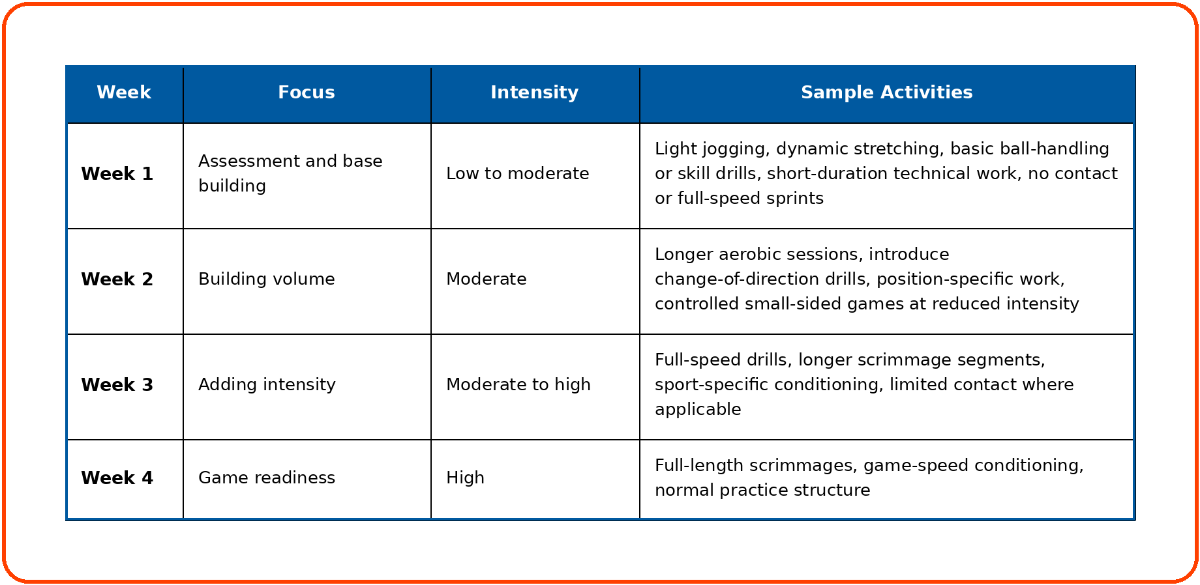
Use the early weeks to actually watch how players move, not just how hard they breathe. A player who's cardiovascularly fine but moving stiffly or favoring a side is telling you something a fitness test won't catch.
How to Communicate the Return Plan to Players and Parents
This is the part most conditioning advice skips, and it's often where things actually go wrong. A few things worth doing before the first practice back:
-
Share the plan in advance. Let parents and players know the first two weeks will look different from a normal practice, and why. It heads off the "why aren't we scrimmaging yet" question.
-
Ask about the break, not just attendance. A short check-in (illness, injury, travel, or simply inactivity during the break) tells a coach who might need extra time before jumping to full intensity.
-
Flag medical clearance early. If any player was injured, sick, or off activity for a medical reason during the break, get clearance sorted before the first full-intensity session, not after someone gets hurt.
-
Set expectations on attendance. The ramp-up plan only works if it's consistent. A player who misses the first week and jumps straight into week two's intensity is right back to the same mismatch the whole plan was designed to avoid.
For a team of fifteen to twenty-five players, doing this by memory or a group text gets messy fast, which is usually where teams start looking for a more structured way to track who's been informed, who's cleared, and who's actually shown up.
Common Mistakes Coaches Make When Restarting a Season
-
Running the first practice like week ten. Full scrimmages and max-effort conditioning on day one, regardless of how long the break was.
-
Treating the whole roster as one fitness level. Ignoring the players who stayed active versus the ones who didn't.
-
Skipping the parent communication step. Assuming everyone understands why the pace is slower for the first couple of weeks.
-
Losing track of who's been cleared to return. Especially after injuries or illness during the break.
-
Not adjusting the plan when players are struggling. Sticking to a fixed schedule even when it's clear the group needs another week at lower intensity.
Where SportsPlus Fits Into the Restart
The conditioning plan above is the same regardless of what tools a team uses. Where things tend to break down is the coordination side: making sure every family sees the return-to-training plan, tracking who's actually shown up to the ramp-up sessions, and keeping a record of who still needs medical clearance before full-intensity work starts.
SportsPlus is built for the administrative side of running a team or club, including team communication and practice scheduling in one place, so a coach isn't relying on a group text and a mental list to track twenty players through a phased return. If your club is coordinating a preseason restart across multiple teams, having attendance and communication centralized removes one of the more common failure points in an otherwise solid conditioning plan.
Final Takeaway
Week one isn’t about working harder to get a squad back into shape after a long break, it’s about closing the gap between what players can accomplish now and what you’re asking of them on a timetable that allows their bodies to catch up. A two- to four-week controlled ramp-up with open communication to players and parents takes a team to full readiness with considerably fewer injuries than jumping directly into game speed.
If your club is organising a preseason restart across multiple squads, SportsPlus can help centralise the scheduling and communication side of that process.
Frequently Asked Questions
How long does it take to get a sports team back in shape after a break?
Most teams need two to four weeks of systematic, progressive work to get back in game form, depending on the length of the break and how active players remained during it.
Is it safe to scrimmage in the first practice back after a long break?
Not usually. Full-speed scrimmages in the first session are a great way to increase the likelihood of strains and overuse issues because tissue conditioning has not yet caught up with cardiovascular fitness. Most teams wait until week three or four for complete scrimmages.
How much fitness does an athlete lose after two weeks off?
Detraining effects can be measured after about two to three weeks of inactivity and increase the longer the hiatus continues. The amount fluctuates based on the person and how active they stayed.
Do all players need the same ramp-up plan?
No. Players who stayed active during the break will be better able to withstand the jump in intensity than those who didn't. There should be a plan for the whole team, but some flexibility for individuals as well.
What should the first practice back actually include?
Light aerobic activity, dynamic stretching, technical and skill drills, and low-intensity small-sided activities. Save full-speed sprints, contact and scrimmages until later weeks.
How do you handle players who traveled, were sick, or were injured during the break?
Before the first practice, do a check-in with each player (or parent for youth athletes) and seek clearance from medical personnel for anyone returning from illness or injury before they participate in any full-intensity sessions.
What's the biggest injury risk when a team returns from a break?
It's not just 'being out of shape' it's the difference between recent training load and the intensity of the first few sessions back. This is guarded by a slow intensification.
How do you communicate a return-to-training plan to parents?
Share the strategy prior to the first practice, explain why the first couple of weeks look different from a normal practice, and identify any medical clearance needed early on instead of after the fact.
Does the ramp-up timeline change for youth sports versus adult recreational teams?
The broad outline is the same, but youth athletes are still growing and developing physically, so coaches should pay extra attention to reports of pain or stiffness, rather than presuming it's typical soreness.
What tools help coaches manage a team-wide restart?
Centralised communication and scheduling technologies can help track who has been notified of the plan, who has attended ramp-up sessions and who needs medical clearance, which can be tough to track manually across a full roster.

Nathan Uppara
Digital Marketing Lead at SportsPlus
Nathan Uppara is the Digital Marketing Lead at SportsPlus, where he helps sports organizations discover better ways to manage registration, payments, scheduling, communication, websites, and mobile apps. He combines his experience in digital marketing and sports technology to create practical content and resources for clubs, leagues, and sports organizations.
Recent

What Should a Modern Sports Organization Website Actually Do?
Oct 2, 202633
Why Generic Website Builders Dont Work for Sports Organizations
Sep 18, 202651
SportsPlus Release Notes-June 30, 2026
Jul 1, 202669
SportsPlus Release Notes-June 09, 2026
Jun 10, 202680
SportsPlus Release Notes-May 19, 2026
May 20, 202671


